
One of the biggest differences between early-career engineers and experienced product developers has very little to do with technical ability.
It comes down to expectations.
Young engineers naturally expect parts to look like the CAD model. Experienced engineers expect variation. They understand that machining, molding, stamping, and assembly all introduce small differences that accumulate throughout a product.
That perspective changes the way they approach design.
Robust products rarely emerge from a single tolerance analysis or a last-minute design review. They are the result of a development process that continually incorporates manufacturing reality into engineering decisions, long before the first production part is built. As discussed in “Design for Manufacturing Is a Quality Exercise, Not a Cost Exercise,” manufacturability ultimately affects much more than production cost. It influences quality, consistency, yield, and the ability to scale.
Design Parts That Expect Variation
Every manufacturing process introduces variation, so robust products include margin to accommodate it.
Sometimes that means providing clearance for molding flash or gate vestiges on a mating component. Sometimes it means adding lead-ins and chamfers that guide parts together during assembly instead of relying on perfect alignment. Compliant snap features can accommodate small differences in molded dimensions without creating excessive assembly forces. Floating interfaces can absorb dimensional variation between subassemblies while maintaining critical functional relationships.
The same thinking applies to how components are located.
A common instinct is to constrain every surface as tightly as possible. That approach can create assemblies that become increasingly sensitive to normal manufacturing variation. Experienced engineers instead consider which degrees of freedom actually require control. Locating a component with a point, a line, and a plane often provides accurate positioning while allowing small dimensional differences to exist without introducing stress or assembly difficulties.
These decisions may seem minor on a drawing, but they often determine whether a product assembles consistently after hundreds of thousands of production cycles.
Bring Manufacturing Into the Design Process
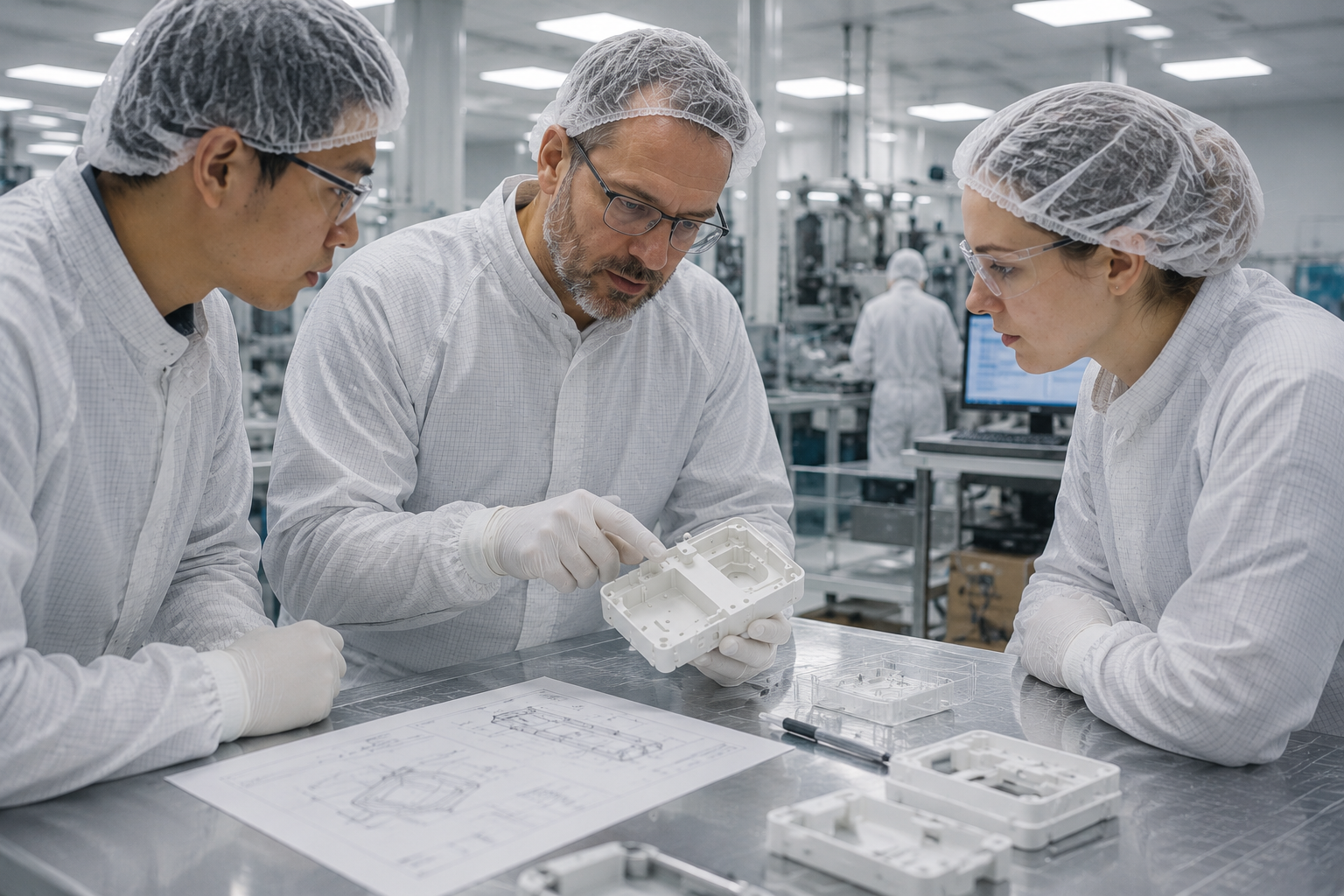
Designing for variation becomes much easier when manufacturing expertise is part of the development team.
Manufacturing engineers, tooling engineers, quality engineers, machinists, mold makers, and experienced production technicians all see products through a different lens. They understand where tooling is likely to wear, where flash tends to accumulate, which dimensions are difficult to control, and which features routinely create assembly challenges. Translating those insights into clear design requirements is also one of the reasons GD&T matters. As explored in “GD&T as a Communication System,” drawings need to communicate functional design intent consistently across engineering, manufacturing, and inspection.
Those perspectives are most valuable while the design is still flexible.
A short discussion with the toolmaker during concept development can prevent weeks of engineering changes after tooling is complete. A manufacturing engineer may recommend a locating strategy that improves yield with almost no impact on product performance. An experienced assembler may identify a feature that is difficult to install repeatedly, even though it appears straightforward in CAD.
These conversations improve products because they introduce practical manufacturing knowledge before decisions become expensive to change.
Verify Robustness Before Production Does
Development should verify more than product performance. It should verify that the product remains functional across the variation expected in production.
Prototype builds assembled under carefully controlled conditions provide valuable engineering feedback, but they seldom represent the full range of manufacturing variation.
Several approaches can improve confidence before launch.
During process validation, engineers can intentionally evaluate parts produced across the operating window established during Operational Qualification. These components often reveal subtle opportunities to improve robustness before commercial production begins.
For particularly critical interfaces, teams can also fabricate components that represent the extremes of important dimensions or functional characteristics. Assembling and testing these intentionally varied parts often exposes sensitivities that remain hidden when every prototype sits near nominal dimensions.
Finding these issues during development is far less expensive than discovering them after production has begun.
The End Result
Resist the urge to demand perfect parts with tight tolerances.
Robust designs are created by development teams that expect variation, design for it, invite manufacturing expertise into the process, and verify performance under realistic production conditions.
Those habits rarely receive much attention after a successful product launch but they do become highly visible when they are missing.
Free Design Evaluation
Wondering whether your design is robust enough for production?
A65 Consulting offers a complimentary Design for Manufacturability consultation to help identify opportunities before they become expensive production problems.
If you would like an objective assessment of your current design, we welcome the conversation.
Email: sdonnigan@a65consulting.com
Or schedule your review online
References
- Boothroyd, G., Dewhurst, P., & Knight, W. A. (2010). Product Design for Manufacture and Assembly (3rd ed.). CRC Press.
- Creveling, C. M. (1997). Tolerance Design: A Handbook for Developing Optimal Specifications. Addison-Wesley.
- Pahl, G., Beitz, W., Feldhusen, J., & Grote, K.-H. (2007). Engineering Design: A Systematic Approach (3rd ed.). Springer.
- Taguchi, G. (2000). Taguchi’s Quality Engineering Handbook. John Wiley & Sons.
- U.S. Food and Drug Administration. (2023). Design Control Guidance for Medical Device Manufacturers. U.S. Department of Health and Human Services.
- ISO. (2011). ISO 1101: Geometrical Product Specifications (GPS) — Geometrical Tolerancing — Tolerances of Form, Orientation, Location and Run-out. International Organization for Standardization.