
Most development teams believe they understand their users. Human factors activities are completed, documented, and validated. Yet use-related problems still emerge once devices enter real clinical environments.
These failures are rarely random. They typically stem from two root causes. The clinical workflow was misunderstood, or human variability was underestimated. Human factors engineering succeeds when both are addressed deliberately during design.
Failure Mode One: Misunderstood Clinical Workflow
Clinical environments impose constraints that are difficult to replicate in development settings. Time pressure, task switching, and interruptions are common. Responsibilities may shift between nurses, physicians, and technicians. Lighting, noise, and sterility requirements affect dexterity and attention. Devices are often used alongside other equipment within tightly choreographed workflows.
If architecture decisions are made based on simplified or idealized task sequences, the resulting interface may appear logical in a design review but conflict with real-world behavior. Usability validation then becomes a test of inaccurate assumptions rather than a confirmation of safe performance.
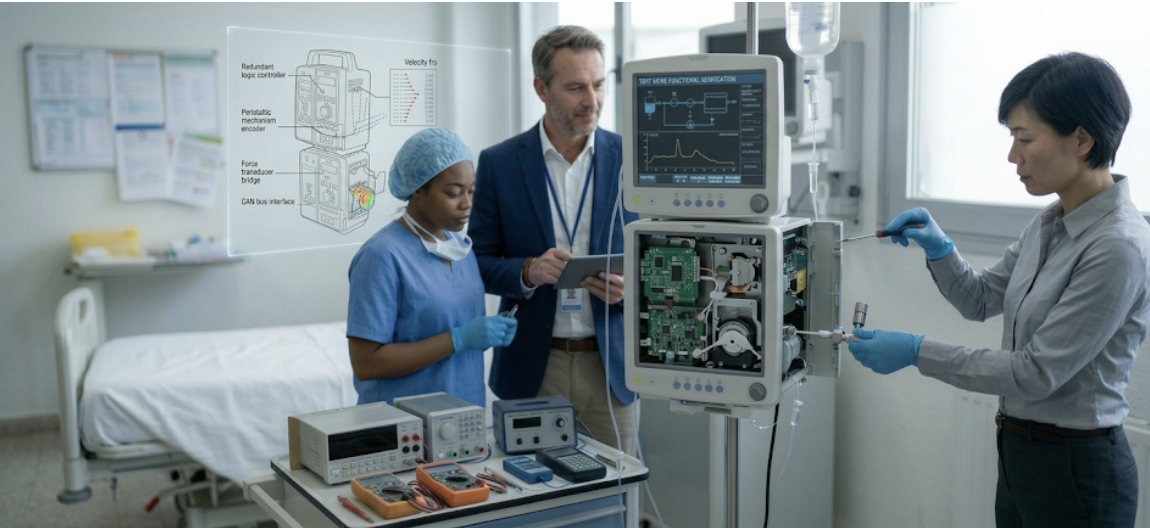
Clinical expertise must therefore be embedded early in development. Clinical professionals should participate in architecture discussions, contribute to task analysis before interface freeze, and evaluate workflow assumptions during concept selection. Their role extends beyond testing. They help expose where design intent diverges from clinical reality while flexibility remains high.
When workflow is modeled accurately, design decisions align with how care is actually delivered rather than how it is described in requirements documents.
Failure Mode Two: Underestimating Human Variability
The second failure mode is subtler and often more consequential. Devices are frequently designed around competent, attentive users who follow instructions precisely. In practice, users vary widely in training depth, experience level, cognitive load, and fatigue. Interpretation of feedback and labeling differs across individuals and institutions.
People interpret intended use in multiple ways. Interfaces that appear clear to engineers may be ambiguous under stress. Steps that seem obvious in a controlled environment may be skipped or performed out of sequence when time pressure increases.
Robust design anticipates this variability. It reduces reliance on memory, minimizes ambiguous states, and provides clear feedback about system status. Forcing functions, sequencing controls, and poka-yoke principles should be applied intentionally to prevent foreseeable misuse. Error-resistant design is a structural risk control, not a refinement added late in development.
Devices deployed in clinical environments must tolerate imperfect execution. Engineering for ideal users introduces fragility. Engineering for real users increases resilience.
Human Factors as Risk Management
Both failure modes connect directly to risk management. Under ISO 14971 and FDA human factors guidance, use-related hazards must be identified and mitigated. Design-based controls are expected to take precedence over labeling and training, which are considered weaker risk controls.
When workflow misunderstandings or user variability are discovered during summative usability testing, teams sometimes attempt to compensate by adding warnings, clarifications, or expanded instructions. This approach rarely addresses the underlying interaction problem and is viewed unfavorably by regulators when used as a substitute for design mitigation. Labeling can support safe use, but it cannot reliably correct structural design weaknesses.
When these issues are discovered late, the consequences often include redesign, additional validation cycles, and delayed submissions. When they escape into the field, they surface as complaints, adverse events, or corrective actions.
Addressing workflow and human variability early strengthens safety margins and reduces downstream instability. Human factors engineering therefore functions as a core risk discipline embedded within product development.
Embedding Clinical Reality in Development
Effective programs integrate clinical reality structurally rather than episodically. Early context-of-use definition, identification of critical tasks before interface freeze, and iterative formative evaluations tied to risk analysis help align design decisions with real-world conditions.
Clinical contributors should be active participants in design evolution, not occasional reviewers. Exposure of architecture and interface decisions to clinical scrutiny during development allows tradeoffs to be resolved when change remains manageable.
This integration reduces the likelihood of late-stage surprises and increases confidence before formal usability validation begins.
Summary
Human factors failures are predictable. They arise when clinical workflow is mischaracterized or when human variability is underestimated.
Devices used in complex clinical environments must be engineered for real workflows and imperfect users. When usability is treated as a risk discipline and integrated early, products enter the field with greater safety, resilience, and stability.
Clinical performance depends not only on how a device functions, but on how reliably it performs in the hands of the people who use it.
Free Human Factors & Workflow Review
If you have an active or upcoming medical device development program, we offer a free 30-minute Human Factors and Workflow review.
This peer-level discussion focuses on:
- Identifying where clinical workflow assumptions may diverge from real-world practice
- Evaluating how use-related risks are being mitigated through design rather than labeling
- Assessing whether human variability has been structurally addressed
- Highlighting potential late-stage usability risks before they surface in validation
Email: sdonnigan@a65consulting.com
Or schedule your review online
References
- U.S. Food and Drug Administration (FDA).
Applying Human Factors and Usability Engineering to Medical Devices: Guidance for Industry and Food and Drug Administration Staff. February 2016.
https://www.fda.gov/media/80481/download - ISO 14971:2019.
Medical devices — Application of risk management to medical devices.
International Organization for Standardization, 2019. - IEC 62366-1:2015 + A1:2020.
Medical devices — Application of usability engineering to medical devices.
International Electrotechnical Commission. - Reason, J.
Human Error. Cambridge University Press, 1990.
ISBN: 978-0521314199
Shingo, S.
Zero Quality Control: Source Inspection and the Poka-Yoke System. Productivity Press, 1986.
ISBN: 978-0915299070